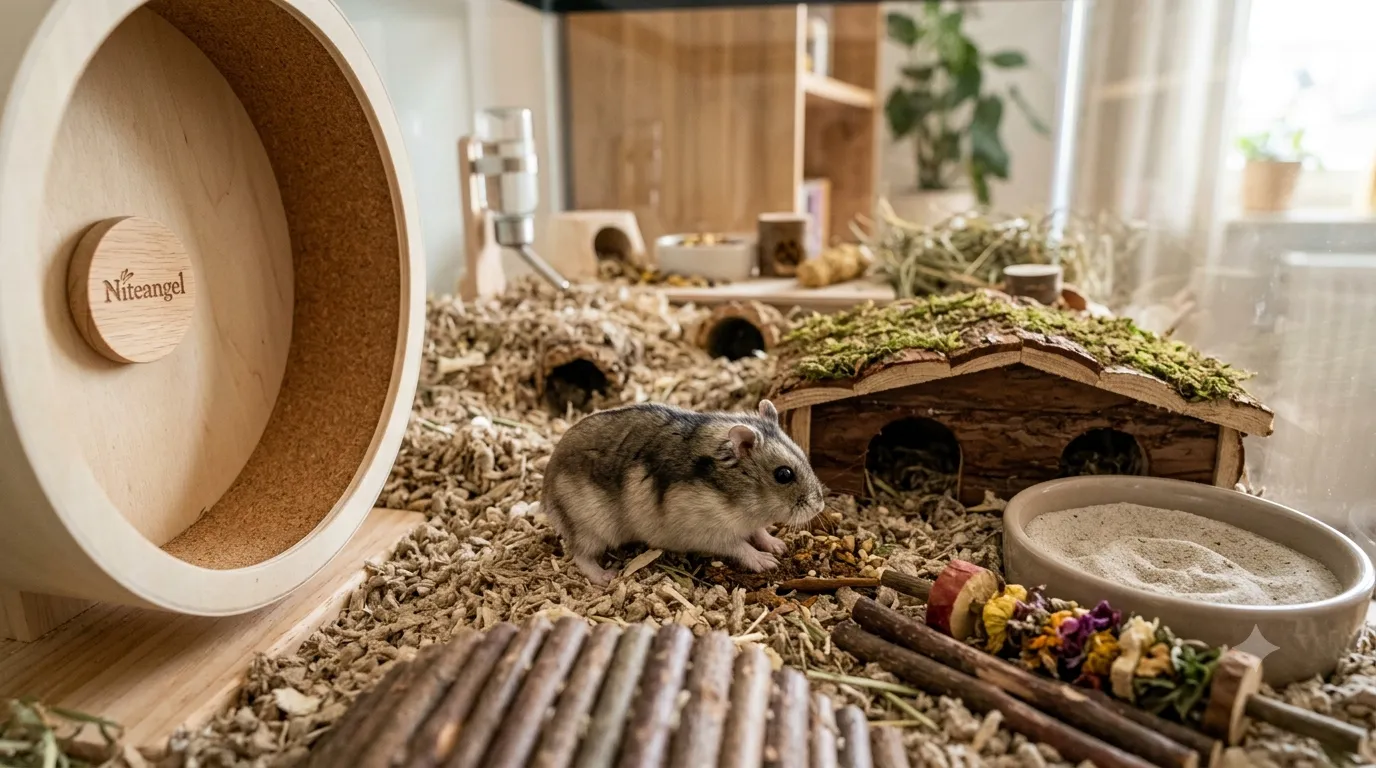
 🏡
🏡How to care for a hamster? Cage, wheel and welfare
How much space and how deep a bedding a hamster really needs, how big its wheel should be, and why it's kept alone - based on welfare research.
- care
- welfare
- cage
Hi, it’s Koko! 🏡 In earlier posts I explained what a hamster is and why we love the wheel. Now the most important question from the point of view of my comfort: how do you set up a home where a hamster is genuinely happy? And not by guesswork - I’ll lean on welfare research. I’m a Djungarian hamster (Phodopus sungorus), so here and there I’ll point out how caring for us dwarves differs from caring for the bigger Syrians (Mesocricetus auratus).
Space: here size really matters
The best evidence comes from a study in which researchers (Fischer, Gebhardt-Henrich and Steiger) watched 60 female Syrian hamsters (Mesocricetus auratus, also called golden) kept singly in cages of four different floor areas: 1,800, 2,500, 5,000 and 10,000 cm². Every cage had the same wheel 30 cm in diameter and 15 cm of bedding.
What did they measure? Among other things, bar-gnawing - a so-called stereotypic behaviour, a repetitive, “empty” movement that in animals often signals frustration. Hamsters in the smallest cages gnawed the bars longest and most often, and those in the largest ones did so significantly less. The authors’ conclusion: welfare improves clearly only at a floor area on the order of 10,000 cm².
10,000 cm² is, for example, a floor about 100 × 100 cm - or 125 × 80 cm. That’s far more than a typical pet-shop cage. The bigger, the better.
But there’s a second, equally important finding that’s easy to forget: hamsters gnawed the bars in all four cage sizes - even the biggest, one-metre one. Floor area, though crucial, is only a fraction of a wild territory (measured in thousands of square metres out there), so a big cage can’t just be “ticked off” without an interesting interior: deep bedding, hideouts and things to do. In the smaller cages hamsters also climbed onto the flat roof of their house more often - trying to make up for the missing horizontal space that way.
Cramped quarters aren’t just about boredom, either - they’re measurable stress. In another study (Kuhnen, 1999) Syrian hamsters in small laboratory cages had a raised resting body temperature and a weaker fever response to an inflammatory challenge than hamsters from larger, enriched cages. That’s a physiological fingerprint of chronic stress: tight housing throws off even thermoregulation, not just mood.
Fischer’s study was on Syrians, but a large, continuous floor is the standard recommended for all hamsters, dwarves like me included. Different bodies quote different thresholds - just remember these are minimums, not the ideal:
| Who recommends it | Minimum floor | Note |
|---|---|---|
| Retail minimum (pet shops) | ~1,800 cm² | criticised in science as too small |
| Veterinary minimum (German TVT) | 5,000 cm² (100 × 50) | official threshold |
| Welfare organisations | 6,000-10,000 cm² | recommended adoption standard |
| Fischer et al. (2007) study | 10,000 cm² (100 × 100) | threshold of a clear welfare gain |
A small body doesn’t mean a small cage!
Bar-biting is a signal, not a quirk
While we’re on the subject: if a hamster persistently chews the bars, that’s not a charming personality trait. In light of the studies above, it’s a hint that something is wrong - most often too little space or too little to do. Instead of getting annoyed, treat it as a request for a bigger, more interesting home.
Deep bedding: an underground castle, not a doormat
I wrote about burrows in the basics, but for setting up a home it’s a top-priority thing - and there’s hard evidence for it. In a study by Hauzenberger, Gebhardt-Henrich and Steiger (2006), 45 male Syrian hamsters were kept on wood-shaving bedding of three depths: 10, 40 and 80 cm. The differences were striking:
- At 10 cm the hamsters gnawed the bars a lot and even racked up excessive kilometres on the wheel - classic signs of tension.
- At 40 cm bar-gnawing dropped clearly.
- At 80 cm stereotypic bar-gnawing vanished completely - in every single hamster.
What’s more, at 40 and 80 cm the hamsters dug real, permanent systems of tunnels and nest chambers and moved into them (a ready-made house became almost redundant), and on the deepest bedding they were also in better physical condition. For me, a dwarf, the takeaway is the same as for the Syrians: what counts is depth, not the mere fact that there’s some bedding on the floor. Aim for a layer you can genuinely burrow into - for us that’s at least a good dozen centimetres, and the more, the more hamster-like.
Cleaning: don’t erase my scent map
I read the world mostly through my nose. I mark my surroundings with secretions from scent glands (we dwarves from the belly, Syrians from the flanks) and build from them a scent “roadmap” of my territory. When you swap out all the bedding at once during a clean, you wipe that map in a second. To a hamster that’s a sudden shock: a jump in heart rate, a burst of stress hormones and exhausting, compulsive re-marking of everything. In an older or weaker animal that stress can lower immunity and end in an infection.
| Instead of this… | …do this | Why |
|---|---|---|
| a full clean-out every 1-2 weeks | spot-clean just the latrine corner every few days | it keeps the scent skeleton of the territory and cuts acute stress |
| replacing all the bedding with new | mix in at least 25-50% of the old, clean bedding with the new | scent continuity, easier re-adaptation after cleaning |
| fluffy “hamster wool” bedding | unscented paper, hay, cellulose, strips of cotton | the fluffy stuff can wrap and amputate limbs and cause fatal blockages if swallowed |
The wheel: it has to fit the back
Since I love running so much, a wheel is a must, not an extra. Diameter is key: a wheel that’s too small forces a hamster to run with its spine bent into a backward arch. In growing animals that leads to permanent skeletal deformity and painful joint changes. This isn’t a loose suggestion but a firm minimum:
- A dwarf hamster like me: minimum 20 cm in diameter (as stated by the German veterinary body TVT), and for adults and larger hybrids, better 25 cm.
- A Syrian hamster: minimum 30 cm (hence the 30 cm wheels in the studies above).
And how big a wheel would a hamster pick itself? In the study by Reebs and St-Onge (2005), Syrian hamsters could choose between different wheels linked by tunnels, and they clearly preferred the bigger one (35 cm) over the smaller (23 cm) and a perfectly circular running surface over a “truncated” one. They didn’t favour a solid plastic surface over a fine, safe mesh with about 9 mm gaps - both were fine by them. The lesson: you can’t overdo wheel size upward, as long as it’s round and has a smooth, continuous running surface.
What to avoid like the plague:
- Rung wheels and wheels with cross-bar stands (a bracket on each side). When a hamster jumps off a spinning wheel, a paw, head or tail can get caught between the fixed stand and the turning rung - the so-called scissoring effect, ending in a fracture or amputation. A proper wheel has a solid back, an open front and a smooth running surface.
- Exercise balls (the plastic ones a hamster rolls around the floor in). They look like fun, but for us they’re a trap: a hamster shut in a ball doesn’t run for joy - it runs in panic from a barrier it can’t investigate. Our most important senses are blocked - whiskers (touch), smell and orientation - and on top of that we crash blindly into furniture. It’s not a toy, it’s a source of stress.
Not just diameter: the running surface and worn paws
A good diameter still isn’t the end of the story - what you run on matters too. A study by Veillette, Guitard and Reebs (2010) showed it in young Syrian hamsters. Their wheels had a running surface of metal bars - and within just 15 days, small wounds on the paw pads and toes appeared in 100% of the males and at least 75% of the females. Hamsters with a blocked wheel (the control) had none at all. This wasn’t an infection from the cage; it was pure abrasion from paws rubbing on a hard surface over thousands of revolutions a night.
The way the wounds were treated says a lot about prevention. Rubbing them with vitamin E did nothing. The only thing that healed them was temporarily blocking the wheel - but that’s a poor fix, because the wheel is too important to a hamster to take away. So it’s far better to prevent the wounds than to treat them:
- A solid, smooth running surface instead of bars or wire. Hard rungs wear the paws fastest (and, as noted above, risk that scissoring effect).
- Soft bedding. In earlier work by the same team (Beaulieu and Reebs, 2009), hamsters on soft pine shavings had fewer wounds than those on hard hardwood flakes.
- Cleanliness. A small graze in dirty, damp bedding infects easily - in this study one hamster developed pododermatitis (inflammation of the foot skin, aka bumblefoot) from such a graze and had to be pulled from the experiment. So keep the latrine corner clean as you go (see above), and check the paws now and then.
They studied Syrians, but the mechanics are the same for every runner, us dwarves included: the harder the surface and the more kilometres, the greater the risk of worn paws.
One hamster per cage - always
This is the single most important welfare rule and it has no exceptions: one hamster = one cage. It’s worth understanding where it comes from, though, because the truth about wild hamsters is more interesting than a plain “they’re loners”.
In the wild, the genus Phodopus isn’t uniformly antisocial at all:
- Campbell’s dwarf hamster can even be socially monogamous - the male stays with the female and helps raise the young (which lets the pups survive better in an extremely dry climate).
- The Djungarian hamster, that’s me, can form loose groups in winter and huddle together in the burrow (huddling cuts the energy spent on heating by tens of percent).
- The Syrian hamster is a loner through and through - in the wild, neighbouring burrows sit an average of over a hundred metres apart.
So why is every one of them, Djungarians included, kept singly in a cage? Because in the wild, harmony depends on being able to move apart. As we grow up (roughly between 2.5 and 8 weeks of age), the density of oxytocin receptors in our brains drops - in the study by Beery, Lee and Cooke (2025) most sharply in the endopiriform nucleus (in both species) and in hippocampal area CA2 (in Syrians). This biological switch turns off the need for company and turns on territoriality, which in the wild drives the young to disperse, each its own way.
In a cage - even a one-metre one - there’s nowhere to disperse to. The weaker hamster can’t escape or stake out a scent territory of its own, so the conflict escalates: chronic stress, fights over resources, deep bite wounds (often to the belly and genitals) and, in the end, the death of the weaker one. Among hobby keepers, attempts to house dwarves in a group end in blood in the vast majority of cases. The nicest gift for me isn’t a cage-mate - it’s more space of my own and things to do (I go into this in the hamster basics too).
A hamster cheat sheet: myth vs science 🐹
| Popular myth / cheap standard | What the science says |
|---|---|
| “A small hamster only needs a small cage” | Minimum ~10,000 cm² of continuous floor, more is better |
| “A bit of shavings on the floor is plenty” | Deep bedding to dig in (a dozen-plus cm for us) quiets stereotypies |
| “The cage must be scrubbed clean every week” | Spot-clean and leave 25-50% of the old bedding, so the scent map survives |
| “Any wheel is fine as long as it spins” | Solid, round surface; min. 20-25 cm for a dwarf, 30 cm for a Syrian; no rungs or balls |
| “A hamster won’t hurt itself on a good wheel” | Intense running on a hard, barred surface wears the paws raw (wounds in 100% of males in Veillette’s study) - a solid surface, soft bedding and a clean cage protect them |
| “Djungarians like company” | All hamsters are loners - always one per cage |
Get this right, and your hamster will repay you with exactly what you see from me live on the home page - joyful, night-time kilometres on the wheel. 🌙💨
📚 What this is based on
This post is based on the sources below - mostly scientific publications. Dig into them if you want to go deeper.
- Behaviour of golden hamsters (Mesocricetus auratus) kept in four different cage sizes — Fischer, Gebhardt-Henrich, Steiger, Animal Welfare (Cambridge University Press), 2007
- The influence of bedding depth on behaviour in golden hamsters (Mesocricetus auratus) — Hauzenberger, Gebhardt-Henrich, Steiger, Applied Animal Behaviour Science, 2006
- The effect of cage size and enrichment on core temperature and febrile response of the golden hamster — Kuhnen, Laboratory Animals, 1999
- Running wheel choice by Syrian hamsters (preference for a 35 cm wheel and a circular surface) — Reebs, St-Onge, Laboratory Animals, 2005
- Cause and Possible Treatments of Foot Lesions in Captive Syrian Hamsters (Mesocricetus auratus) - PubMed (20613965) — Veillette, Guitard, Reebs, PMC / NCBI, 2010
- Declines in oxytocin receptor density and social behavior across a dispersal-like transition in solitary hamsters — Beery, Lee, Cooke, Developmental Neurobiology, 2025
- Cage advice and the evidence behind it — Hamster Welfare
- Wheels - advice and evidence (wheel size, incl. min. 20 cm for dwarves per TVT) — Hamster Welfare
- Winter white dwarf hamster (Phodopus sungorus) - housing and social behaviour — Wikipedia
This is a hobby diary kept on Koko's behalf, not veterinary advice. Always ask a vet about your own hamster's health.