 🎡
🎡Why do hamsters love the wheel so much?
Is running in circles a sign of captive boredom, or a natural need? What a famous study of wild animals revealed - explained by Koko.
- wheel
- behaviour
- science
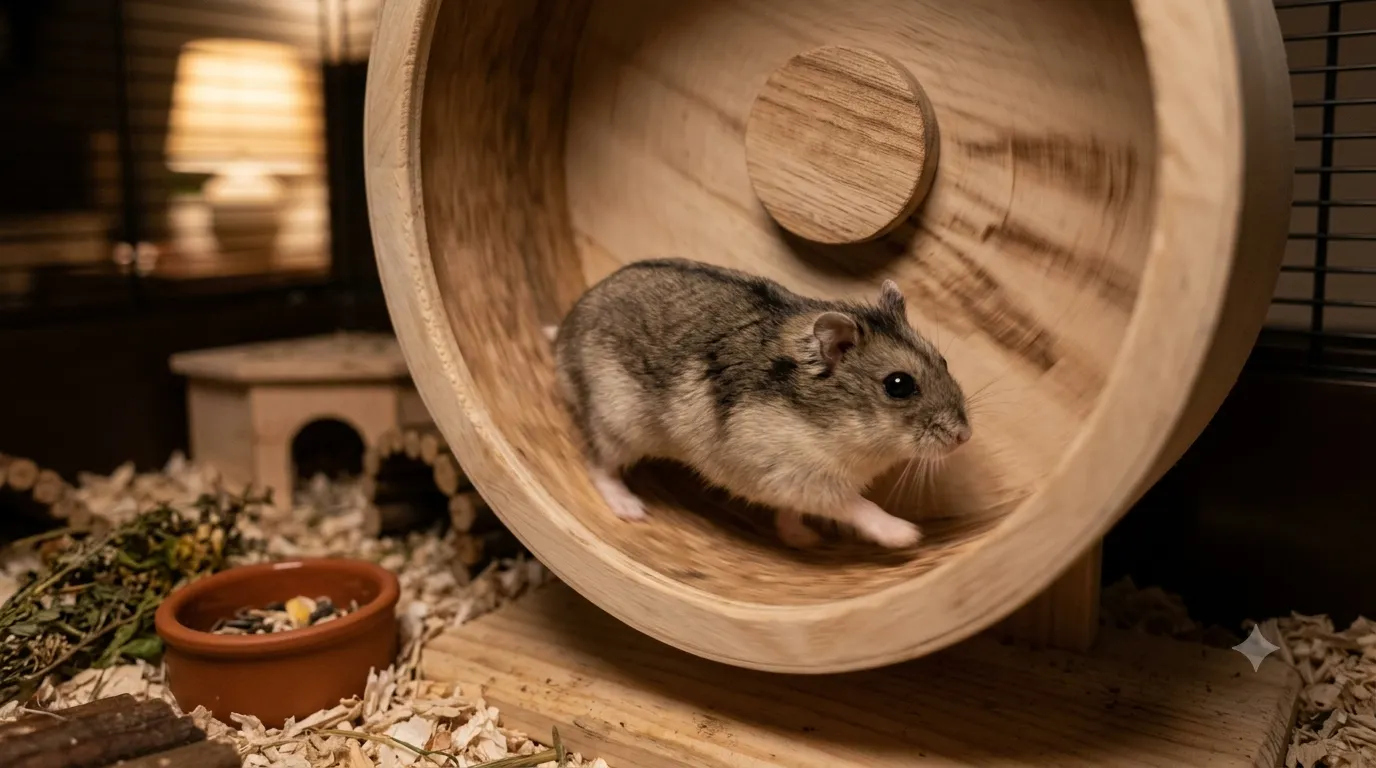
Hi, it’s Koko! 🎡 Since this whole site revolves around my wheel, it’s about time I answered a question that’s probably crossed your mind more than once: why do I run in circles so eagerly? Isn’t this just a bored hamster with nothing better to do?
I’ve got good news for you - science is on my side.
The old accusation: “it’s just cage boredom”
For years there was an argument that wheel running is an artefact of captivity - a strange, repetitive behaviour that an animal develops out of boredom or stress in a cramped cage. Sounds reasonable, right? If that were true, a wild animal would never touch a wheel.
And that’s exactly what someone set out to test.
The experiment that put a wheel… in the wild
Dutch researcher Johanna Meijer, together with Yuri Robbers, did something brilliantly simple. They placed running wheels outdoors - in an urban green area and in dunes off-limits to the public - and for more than three years recorded what happened on camera. They published the results in 2014 in the prestigious Proceedings of the Royal Society B.
And plenty happened. The scientists logged over 200,000 animal visits and analysed more than 12,000 video clips. It turned out that wild mice, of their own accord, hopped onto the wheel and ran - often for stretches as long as their caged cousins.
The crucial detail: no reward
Someone might say, “food probably lured them in.” And yes, at first the researchers put treats by the wheel to attract animals. But the key point is this: the running didn’t stop when the food was removed. The animals kept spinning - with no external reward. That strongly suggests they did it for the sheer pleasure of the movement.
If a wild mouse with an entire meadow at its disposal still chooses to run in a wheel, then the wheel meets some natural need - it isn’t just a prison pastime.
And it wasn’t only mice - though mice accounted for about 88% of all the running. Shrews, rats, frogs and even slugs were caught using the wheel. The only ones dropped from the analysis were snails: they alone turned the wheel chaotically, with no clear direction. The slugs, on the other hand, glided along in one steady direction, so the researchers counted them like any other runner 🐌.
But science adds an important “but”
It would be unfair of me to stop there (and here at the Diary we play it straight). A few years after Meijer’s experiment, two other researchers - Georgia Mason and Hanno Würbel - reminded everyone of a simple truth: just because a behaviour shows up in the wild doesn’t yet mean it’s always healthy in a cage. Problem behaviours often grow out of perfectly normal ones.
Their conclusion is that wheel running has more than one face. Most of the time it’s plain, healthy exercise and fun. But in poor conditions - a small, empty cage, noise, the smell of a predator, nowhere to dig - that same running can turn into a way of coping with stress, as if the hamster were still trying to escape somewhere. The researchers even noticed that animals in barren cages run harder than those in richly furnished ones.
So the wheel alone isn’t the whole story. Healthy running starts with a good home: a large cage, a thick layer of bedding to burrow tunnels in, and a wheel of the right size. Then the running is what it should be - joy, not escape.
What does this mean for me - and for you?
This study neatly debunks the claim that wheel running is merely a symptom of cage life. For us hamsters - animals that in the wild can cover real distances at night while foraging - the wheel is a way to burn off that built-in runner’s energy.
That doesn’t mean any old cage will do, of course - a good wheel has to be the right size so it doesn’t bend my spine, and the cage itself should be spacious (I write about that separately). But the running itself? That’s pure hamster joy.
So next time you watch me clock up the kilometres live, know that it isn’t boredom. It’s me, doing exactly what hamsters love most. 🐹💨
📚 What this is based on
This post is based on the sources below - mostly scientific publications. Dig into them if you want to go deeper.
- Wheel running in the wild — Johanna H. Meijer, Yuri Robbers, Proceedings of the Royal Society B, 2014
- Wheel running in the wild - PubMed (24850923) — PubMed / NCBI, 2014
- What can be learnt from wheel-running by wild mice, and how can we identify when wheel-running is pathological? — Georgia J. Mason, Hanno Würbel, Proceedings of the Royal Society B, 2016
This is a hobby diary kept on Koko's behalf, not veterinary advice. Always ask a vet about your own hamster's health.