 🏜️
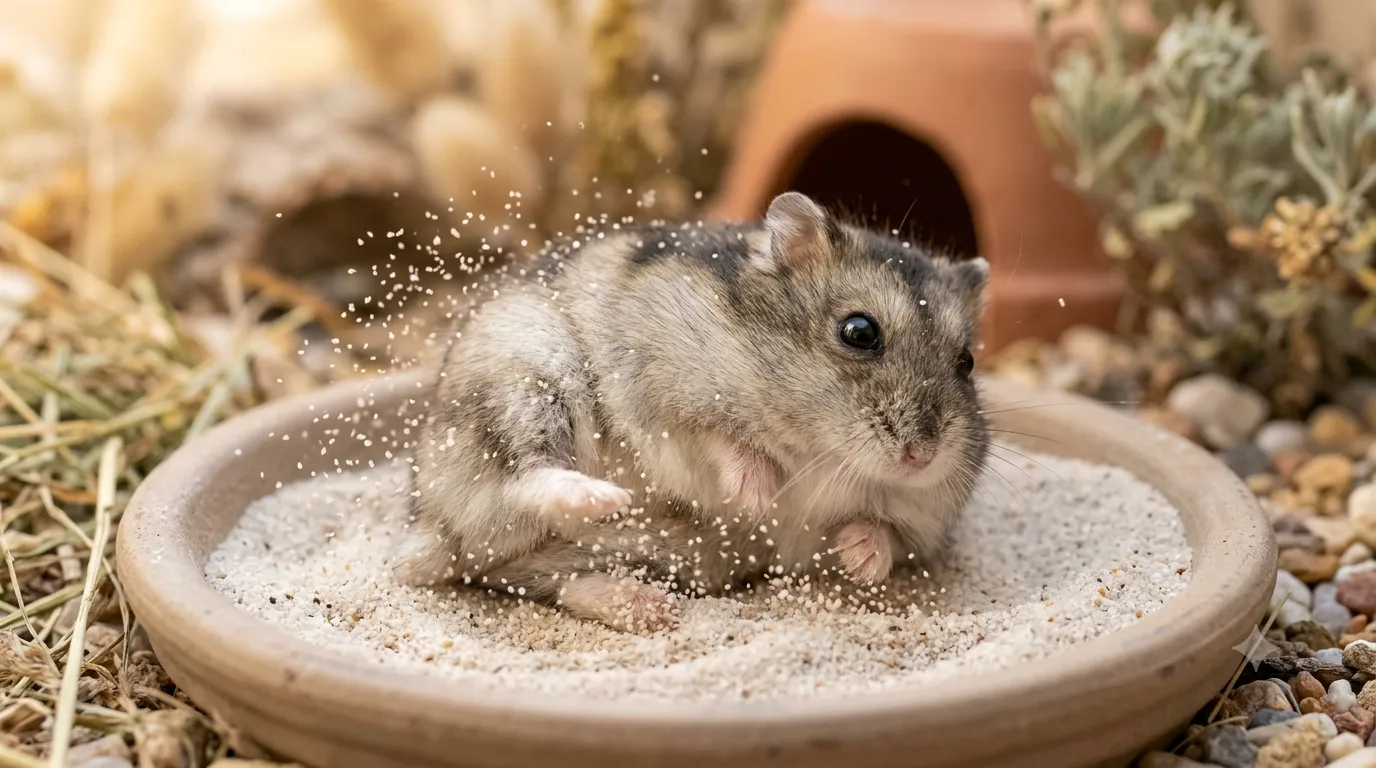
🏜️A sand bath for your hamster - why, and which sand?
Does a hamster need a bath? Why sand and never water, and what deprivation studies on desert rodents tell us about sand bathing - explained by Koko.
- sand
- grooming
- welfare
Hi, it’s Koko! 🏜️ I’ve already written about what a hamster is and how to set up a home for one. Today, a subject many keepers only figure out after the fact: bathing. Because yes, a hamster does need a bath - just a completely different one from what most people picture. Not soap and water, but dry sand. And this isn’t a whim: science has actually looked at it rather closely.
First, a warning: never bathe me in water
Before I get to the sand, one rule that outranks all the others: you do not bathe a hamster in water. This isn’t about my mood, it’s about biology.
My fur is coated in a thin layer of natural oils (skin sebum). That isn’t dirt - it’s a functional barrier that helps me hold on to warmth and protects my skin. Soap and water strip that layer down to nothing. On top of that I’m tiny, I have a huge body surface relative to my mass, and I lose heat in a flash. A wet, frightened hamster is a real risk of shock, chilling and, in extreme cases, death. That’s why welfare bodies like the RSPCA are blunt about it: no water baths. If something genuinely does get stuck in my coat, gently wiping that spot with a slightly damp cloth or a soft brush is all that’s needed.
So if water is off the table, how do I wash? With sand, of course.
A sand bath isn’t a toy. It’s a documented need
Here’s where it gets interesting, because while hamsters themselves haven’t been studied much on this, my desert cousins certainly have - and thoroughly. And since here at the Diary we play it straight, I’ll say plainly where our knowledge actually comes from.
The strongest evidence that sand bathing is a real, regulated need rather than idle play comes from deprivation experiments. In the classic study by Tortora, Eyer and Overmann (1974), Mongolian gerbils were cut off from sand for 0, 2, 4, 6 and 8 days. The result? The longer they went without it, the more intensely they bathed once the sand came back - and the more they scent-marked their territory. That’s the textbook picture of a built-up need: something that swells while it’s blocked and bursts out the moment it’s available again.
The very same thing shows up in chinchillas. In the study by Stern and Merari (1969), chinchillas deprived of their bath bathed more, and differently, once given it back - again a rebound after deprivation, the hallmark of a genuinely motivated behaviour rather than a passing fancy.
What is the sand actually for? It’s about the oils
The conclusion drawn from these studies is known as the “oil regulation hypothesis”: by rolling in sand, the animal regulates how much grease sits on its coat. Licking alone doesn’t cut it - dry, fine sand acts like a dry sponge and lifts away the excess sebum and glandular secretions that the tongue can’t manage.
- A review of sebum in mammals (Vanderwolf, Kyle and Davy, 2023) explicitly lists gerbils among the animals that sand-bathe to remove excess lipids from their fur.
- And that this is physiology, not cosmetics, is shown by Harriman and Thiessen (1983): in gerbils, sand bathing strips Harderian gland secretions from the coat and by doing so helps with water balance - animals that couldn’t bathe lost more body mass when water was short. In the desert every drop counts, and a clean coat literally helps save it.
Why does this concern me too? Because we hamsters are animals of dry, dusty steppes and semi-deserts - I, a Djungarian hamster, come from the dry steppes of Kazakhstan and southern Siberia, and the Syrians from the arid region around Aleppo. We have the same slightly oily fur and the same scent glands (we dwarves on the belly, Syrians on the flanks) that tend to get greasy. Hard experiments on hamsters specifically are thin on the ground, so to be honest: a lot of this we infer from close relatives. But the mechanics are the same, which is why vets and welfare bodies agree in recommending a permanent sand bath in the cage as a natural way to look after the coat and skin.
Sand - yes. Dust - no
The single most important practical detail, and an easy one to trip over: it must be sand, not dust. A very fine, powdery dust (like the kind sold to chinchillas for their “dust baths”) kicks up into the air easily and, breathed in day after day, irritates the airways - in a creature as small as me that’s a straight road to respiratory trouble. The RSPCA puts it simply: use sand, not dust.
What else to watch for when choosing:
| Good sand | What to avoid |
|---|---|
| Fine, washed and baked sand (e.g. certified children’s play sand) | Chinchilla bathing dust - too fine, dusty, irritates the lungs |
| Calcium-free reptile sand | Calcium / ground-limestone sand - clumps and turns dusty |
| Unscented sand with no dyes | Perfumed or coloured sand - needless chemistry on the skin |
| Smooth, rounded-grain sand | Sharp builder’s sand - can be abrasive |
If you’re using ordinary sand, it’s worth rinsing it and baking it in the oven (to get rid of dust and microbes) and then sifting it. The goal is a dry, loose material in the dish with no cloud rising off it.
How to offer it the hamster way
- A container big enough for me to fully roll and dig in - not a shallow saucer but a proper bowl, a jar laid on its side, or a small tub. The more room to roll, the better.
- A layer of sand a few centimetres deep - enough to press into sideways, not just brush the surface.
- Leave the sand bath in the cage permanently. This isn’t a supervised “bath session” like a chinchilla’s; it’s a fixture I use whenever I feel the urge myself.
- Sift it daily. Many of us also take a liking to the sand as a… toilet - which is actually handy, since it keeps the latrine in one place. Scoop out the clumps and swap the sand for fresh from time to time.
And that’s the whole philosophy. No water, no soap, no scrubbing - just a dish of clean, fine, safe sand for me to roll around in to my heart’s content. For you it’s a simple addition; for me it’s a little piece of the steppe in my cage. Next time you watch me live, I might just be shaking the sand off before I hop onto the wheel. 🐹✨
📚 What this is based on
This post is based on the sources below - mostly scientific publications. Dig into them if you want to go deeper.
- The effect of sand deprivation on sandbathing and marking in Mongolian gerbils (Meriones unguiculatus) — Tortora, Eyer, Overmann, Behavioral Biology, 1974
- The bathing behavior of the chinchilla: Effects of deprivation — Stern, Merari, Psychonomic Science, 1969
- Removal of Harderian exudates by sandbathing contributes to osmotic balance in Mongolian gerbils — Harriman, Thiessen, Physiology & Behavior, 1983
- A review of sebum in mammals in relation to skin diseases, skin function, and the skin microbiome — Vanderwolf, Kyle, Davy, PeerJ, 2023
- Hamster - sand bath (use sand not water, and a safe type of sand) — RSPCA
- Winter white dwarf hamster (Phodopus sungorus) - dry steppe as natural habitat — Wikipedia
This is a hobby diary kept on Koko's behalf, not veterinary advice. Always ask a vet about your own hamster's health.